
History & approaches
What Was the First Self-Driving Car?
There is no single first self-driving car; it depends on what you count. A radio-controlled car drove through New York in 1925, test cars followed wires buried in the road in the 1950s, and the first car that steered itself by watching the road with cameras was built in Tsukuba, Japan, in the late 1970s.
Why is the first self-driving car a hard question?
Early driverless cars fall into three very different groups. Some were steered remotely by a person in another vehicle. Some followed guidance built into the road, such as buried wires. Only the third group perceived the road on their own, with cameras or other sensors, and decided how to steer. Only that third group is self-driving in the sense the phrase has today.
Which car counts as first depends on which group you mean, and that is why popular answers range from the 1920s to the 2000s.
The early experiments, from the 1920s to the 1960s
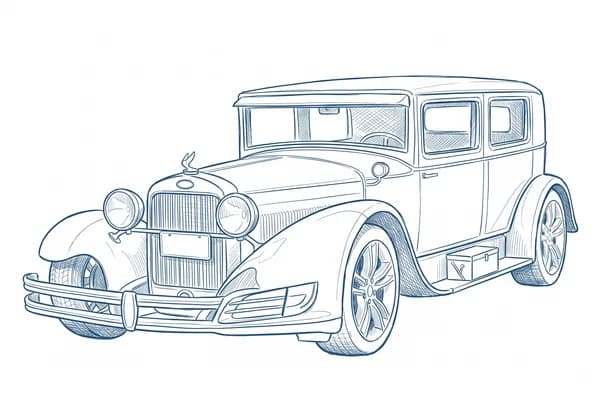
On 27 July 1925, a company called Houdina Radio Control sent a driverless Chandler sedan up Broadway and down Fifth Avenue in New York. It was steered by radio from a second car following behind, so it was remote controlled rather than self-driving. The demonstration ended when it crashed into another car.
In 1939, General Motors' Futurama exhibit at the New York World's Fair imagined automated highways where cars were guided by circuits built into the road. It was a vision, not a working car. In October 1957, RCA and the State of Nebraska demonstrated a car guided by detector circuits buried in a 400-foot stretch of highway near Lincoln. The car followed the wires in the road but could not see anything.
The first car that watched the road: Tsukuba, late 1970s
The first car that steered itself by looking at its surroundings is usually credited to Sadayuki Tsugawa's team at Japan's Mechanical Engineering Laboratory in Tsukuba. It used two TV cameras and analog signal processing to follow markings on a test course, at about 30 km/h (under 20 mph).
The car is commonly dated to 1977, but the team's first published paper on it appeared in 1979, and Tsugawa later described it as a mid-1970s project. However it is dated, it marks the start of machine vision as the way cars would come to drive themselves.
Highway speeds in real traffic: Dickmanns and Navlab
In Germany, Ernst Dickmanns' team at the Bundeswehr University Munich built VaMoRs, a Mercedes van that drove itself from 1986. In 1987 it covered more than 20 km of an empty autobahn at up to 96 km/h, controlling both steering and speed. His work continued in the European EUREKA PROMETHEUS program (1987 to 1995), one of the largest driving research efforts of its time.
In October 1994, Dickmanns' car VaMP and Daimler-Benz's twin VITA-2 drove in normal three-lane traffic near Paris at up to 130 km/h, changing lanes with a safety driver approving each move. In 1995, VaMP drove about 1,600 km from Munich to Odense, Denmark, about 95 percent of it automatically, at speeds of up to 180 km/h.
In the United States, Carnegie Mellon's Navlab program started in 1984. Its researchers built ALVINN, a small neural network that learned to steer from camera images, published in 1989. In July 1995, Dean Pomerleau and Todd Jochem drove Navlab 5 from Pittsburgh to San Diego in their "No Hands Across America" trip. The car's vision system steered for 98.2 percent of the roughly 2,850 miles, while the humans handled the accelerator and brakes.
| Year | Milestone | What it proved |
|---|---|---|
| 1925 | Houdina's radio-controlled car, New York | A car could move without a driver aboard, but a person still steered it remotely |
| 1957 | RCA and Nebraska buried-wire test | Road infrastructure could guide a car, but only where it was built |
| Late 1970s | Tsugawa's camera-guided car, Tsukuba | A car could steer by seeing the road for itself, at low speed |
| 1987 | Dickmanns' VaMoRs on the autobahn | Machine vision could drive at highway speed |
| 1995 | VaMP, Munich to Odense, and Navlab 5, No Hands Across America | Long trips in real traffic, with humans still supervising |
From research labs to a race
These projects proved the idea in labs and on test drives, but they stayed research. In March 2004, DARPA's first Grand Challenge turned self-driving into an open competition, sending robot cars across the Mojave Desert with no one aboard. None finished that year, but the races that followed created the generation of engineers who went on to build today's industry.
Read: The DARPA Grand Challenge: the big bang of self-driving →
Watch
Frequently asked
- Who invented the self-driving car?
- No single person did. Sadayuki Tsugawa in Japan, Ernst Dickmanns in Germany and Carnegie Mellon's Navlab team, including Dean Pomerleau, each built early vision-guided cars between the late 1970s and the 1990s.
- When was the first self-driving car made?
- The first camera-guided car is usually dated to 1977, in Tsukuba, Japan, although its first published paper is from 1979. A radio-controlled car drove through New York in 1925, but a person steered it remotely.
- Was the 1925 American Wonder a self-driving car?
- No. It had no driver aboard, but an operator in a second car steered it by radio, so it was remote controlled.
- Did a self-driving car cross the United States before Google?
- Yes. In 1995, Carnegie Mellon's Navlab 5 steered itself for 98 percent of a 2,850-mile trip from Pittsburgh to San Diego, while the humans aboard handled the accelerator and brakes.
- How fast were the early self-driving cars?
- The Tsukuba car reached about 30 km/h. Dickmanns' VaMoRs reached 96 km/h on an empty autobahn in 1987, and his VaMP reached 180 km/h in 1995.
Keep learning, once a week
The weekly digest: the stories worth your time from the autonomous vehicle industry, hand-picked by people who work in it. No marketing gloss.