
How it works
Autonomous Trucking, Explained
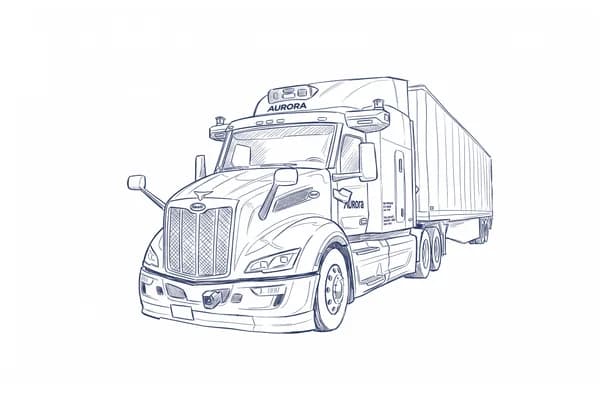
Autonomous trucking uses automated driving systems to drive heavy freight trucks, starting on highways between terminals near interstates. Since 2025 a few companies, led by Aurora in Texas, have hauled paying freight with no one driving, while people still handle local pickup and delivery at each end of the trip.
Why are self-driving trucks starting on highways?
Highways are a narrower driving task than city streets. There are few pedestrians or cyclists, no traffic lights, consistent lane markings and more predictable traffic, which makes for a simpler operational design domain.
Highways are not easy, though, just differently hard. A loaded truck at highway speed needs a long distance to stop, so the system has to see far ahead. Aurora says its lidar sees more than 450 meters, which it calculates as about nine seconds of warning at 65 mph.
How does the hub-to-hub model work?
Most autonomous trucking plans use transfer hubs: terminals next to an interstate where trailers switch between trucks. A human-driven truck brings the trailer from the shipper to the hub, the autonomous truck drives the long highway stretch to another hub, and a human driver completes the local delivery.
A study by Georgia Tech researchers, commissioned by the truck leasing company Ryder, estimated that this model could cut costs by 29 to 40 percent. In May 2026 the food distributor McLane signed on for exactly this setup in Texas, with Aurora driving between terminals.
Who is running driverless trucks?
Aurora announced on 1 May 2025 that it had begun regular driverless runs on Interstate 45 between Dallas and Houston, with Uber Freight and Hirschbach as launch customers. Later that month it moved an observer from the back seat to the driver's seat at the request of the truck maker PACCAR, citing prototype parts in the base vehicle; the observer does not drive. Night runs followed in July 2025, and by February 2026 Aurora ran five corridors, including Fort Worth to Phoenix, about 1,000 miles.
In July 2026 Aurora launched second-generation hardware on International trucks with no one aboard, and it says it has driven more than 500,000 driverless miles. Its goals of 200 driverless trucks by the end of 2026 and more than 30,000 by 2030 are targets, not results.
The field has also seen exits. Embark wound down in 2023, Waymo paused its trucking program in July 2023 to focus on robotaxis, and TuSimple left the US market in 2023 and renamed itself CreateAI in 2024.
| Company | What it does | Status (September 2026) |
|---|---|---|
| Aurora | Class 8 trucks on Texas and Southwest interstates | Driverless commercial freight since 2025 |
| Kodiak | Trucks hauling frac sand in the Permian Basin, mostly on private lease roads | Driverless, customer-owned trucks since December 2024 |
| Gatik | Medium-duty box trucks on short regional routes | Driverless operations announced at scale in January 2026 |
| Einride | Electric cabless pods at a GE Appliances site in Selmer, Tennessee | Daily operations since November 2023 |
| Waabi | Autonomous trucks built with Volvo | Testing with safety drivers; driverless is a target |
| Bot Auto | Hub-to-hub trucking from Houston | First run with no human aboard in September 2025 |
What is the economic case?
US hours-of-service rules limit a truck driver to 11 hours of driving after 10 hours off duty. An autonomous truck is not bound by those limits, so a single truck can cover a 1,000-mile lane without a mandatory rest stop. That continuous operation is the core of the business case.
The industry also points to a driver shortage: the American Trucking Associations estimated about 60,000 drivers short in 2023. That framing is contested. A 2019 analysis in the Bureau of Labor Statistics' Monthly Labor Review found the driver labor market works like other blue-collar markets and linked high turnover to pay and hours rather than a lack of drivers.
What about drivers and safety?
The Teamsters union has backed bills in several states that would require a human operator in heavy autonomous trucks. In California, two such bills passed the legislature and were vetoed by Governor Newsom in 2023 and 2024, who said the state DMV already had authority to regulate. The DMV adopted heavy-duty autonomous vehicle rules in April 2026, and the first testing permits, with safety drivers, followed in August 2026. Texas, where none of the human-operator bills passed, is the center of deployment.
Aurora has published a safety case framework and had parts of it assessed by outside firms, though those assessments were commissioned by the company. Critics, including a widely shared 2025 video report by More Perfect Union, have raised concerns about safety oversight and job losses.
Watch
Frequently asked
- Are there self-driving trucks on the road now?
- Yes. Since 2025 a few companies, led by Aurora in Texas, have hauled paying freight with no one driving. Fleets are still small, in the hundreds at most by the end of 2026.
- Where do autonomous trucks operate?
- Mostly on interstates in the US Sun Belt, especially Texas, including Dallas to Houston, Fort Worth to El Paso and routes to Phoenix and Laredo. Smaller operations run in oilfields and on regional box-truck routes.
- Will self-driving trucks replace truck drivers?
- Not soon, and not every job. Current plans automate long highway legs while people still do local pickup and delivery. Unions and economists disagree about the long-term effect on jobs.
- Why are autonomous trucks starting on highways?
- Highways have fewer pedestrians, no traffic lights and predictable lanes, so the driving task is narrower. A heavy truck at speed still needs to see hundreds of meters ahead to stop safely.
- What is a transfer hub?
- A terminal next to an interstate where trailers switch between human-driven and autonomous trucks. The autonomous truck covers the long highway stretch between hubs.
Keep learning, once a week
The weekly digest: the stories worth your time from the autonomous vehicle industry, hand-picked by people who work in it. No marketing gloss.